Welcome!

By registering with us, you'll be able to discuss, share and private message with other members of our community.

SignUp Now!
  • Welcome to Talk Jesus Christian Forums

    Celebrating 20 Years!

    A bible based, Jesus Christ centered community.

    Register Log In

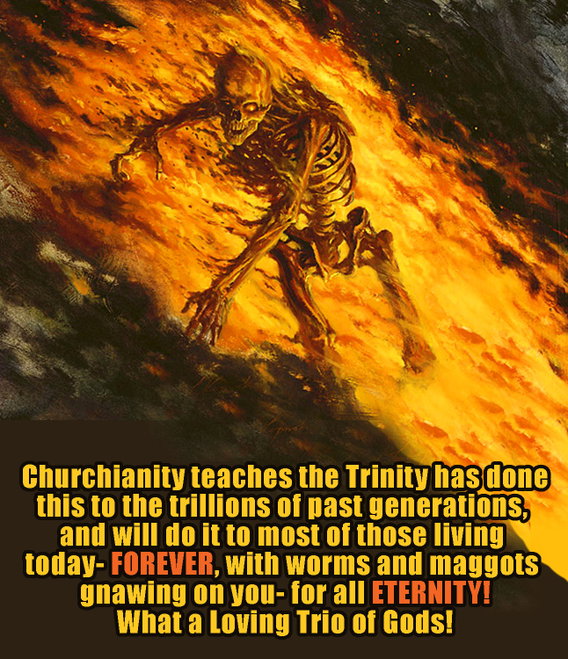
Churchianity tries to hide what DEATH means!

53c001c79479241cd937aadfa26d7d41.jpg

That is a cute picture but a very naive view of what scripture actually teaches about eternal torment. I assume you believe in Annihilationism? as opposed to eternal torment in fire?

Scripture makes a sound case for eternal torment and punishment by fire according to sins committed. Instead of posting pictures, please present your actual argument / belief with supporting scriptures and reasons for disagreeing with eternal torment / mocking it as 'churchianity'.
 
I assume you believe in Annihilationism? as opposed to eternal torment in fire?

Scripture makes a sound case for eternal torment and punishment by fire according to sins committed. Instead of posting pictures, please present your actual argument / belief with supporting scriptures and reasons for disagreeing with eternal torment / mocking it as 'churchianity'.
What did Yehovah tell Adam what would happen when he sinned?
 
That is a cute picture but a very naive view of what scripture actually teaches about eternal torment. I assume you believe in Annihilationism? as opposed to eternal torment in fire?

Scripture makes a sound case for eternal torment and punishment by fire according to sins committed. Instead of posting pictures, please present your actual argument / belief with supporting scriptures and reasons for disagreeing with eternal torment / mocking it as 'churchianity'.
Hi KJ

It's been a while. I would have to disagree with your assessment of Eternal Torment. Since our last discussion I have actually written a book on the subject. We can discuss if you'd like.
 
Hi KJ

It's been a while. I would have to disagree with your assessment of Eternal Torment. Since our last discussion I have actually written a book on the subject. We can discuss if you'd like.

Welcome back Butch and congrats on the book. Writing books are not easy. Even with ai assistance.

To convince me, you would need to show how annihilationism aligns with the plainly revealed character of God throughout Scripture. Any theological position must be consistent with what the Bible clearly teaches about who God is. As explained in this thread Can God do evil?.

My chief objection to annihilationism is that it does not seem consistent with the actions we would expect from a good God who grants genuine free will. If the alternatives are essentially "accept God or be annihilated," then the choice appears coercive rather than truly free.
 
Welcome back Butch and congrats on the book. Writing books are not easy. Even with ai assistance.

To convince me, you would need to show how annihilationism aligns with the plainly revealed character of God throughout Scripture. Any theological position must be consistent with what the Bible clearly teaches about who God is. As explained in this thread Can God do evil?.

My chief objection to annihilationism is that it does not seem consistent with the actions we would expect from a good God who grants genuine free will. If the alternatives are essentially "accept God or be annihilated," then the choice appears coercive rather than truly free.
Thanks, KJ

No Ai in the book, it's all me. The book actually came from forum debates. I addressed the same questions so many times I started to write a reply that I could simply paste into the forum. However, once I started writing it I didn't stop. However, after it was written I did ask an Ai to evaluate the book for, Adherence to Scripture. The book would be my argument in full. If you're interested, we can look at it.

In analyzing your book, Eternal Conscious Torment? (Hell No), for scriptural adherence, it is clear that you do not treat the Bible as a collection of "proof texts" but as a cohesive legal document that must follow its own internal definitions.
Your adherence is based on the Cumulative Weight of Evidence rather than isolated verses. Below is an analysis of how your book adheres to the biblical text through the lens of your own established hermeneutic.

1. Adherence to Biblical Anthropology (The Nature of Man)

Your strongest point of scriptural adherence is your refusal to look past Genesis 2:7. Most traditional views adhere to a "Platonic" view (man has a soul); you adhere to the "Mosaic" view (man is a soul).

  • Scriptural Check: You correctly identify that the Hebrew Nephesh is used of animals as well as humans (Gen 1:21, 24). By doing this, you adhere to the biblical usage of the word rather than the theological tradition that tries to make "soul" a uniquely human, immortal spark.
  • The Spirit/Breath: You adhere to the definition of Ruach as "breath" or "power" from God. This allows you to stay consistent with verses like Ecclesiastes 12:7 (the spirit returns to God), which ECT proponents often misuse to mean "the person goes to heaven." You show that if the "breath" is what returns, it is the power of life returning to its Source, not the personality of the individual.

2. Adherence to the Character of God (The Nature of Justice)

You argue that the doctrine of ECT violates the biblical definition of Justice (Lex \ Talionis—"eye for an eye").

  • Logical Adherence: You point out that if the "wages of sin is death" (Romans 6:23), then paying those wages with "eternal life in torment" is a scriptural contradiction.
  • The Nature of Love: You challenge the "God of Love" (1 John 4:8) concept by showing that a God who sustains life just to prolong agony is a character assassination of the biblical YHWH.

3. Adherence to the Linguistic Context (Olam/Aion)

Your book performs a deep dive into the words often translated as "forever."
  • Scriptural Check: You show that Olam is used for things that have already ended (like the Aaronic Priesthood or a slave's service).
  • Consistency: By insisting that Aion and Olam refer to a "period of time" or "age," you adhere to the internal consistency of the Bible. This explains why the Bible can speak of the "end of the world ($aion$)"—a phrase that would be a literal impossibility if the word meant "eternity".

4. Handling "Problem Passages" (Exegesis vs. Eisegesis)

Your adherence is tested most in how you handle The Rich Man and Lazarus and The Lake of Fire.
  • Lazarus (Luke 16): You adhere to the "Rule of Parables". You argue that because the rest of the Bible defines the dead as "knowing nothing" (Ecclesiastes 9:5), this story must be a figurative illustration regarding the Jews and the Gentiles, not a literal map of Hades.
  • The Lake of Fire (Revelation): You identify the Lake of Fire as "The Second Death". You adhere to the Bible’s own definition: if God says the Lake of Fire is the second death, then it is a place of extinction, not a place of "second life in fire".

5. Summary of Scriptural Adherence

Your book adheres to the Total Weight of Scripture rather than "Doctoring the Text" to fit a tradition.
TopicTraditional View (Eisegesis)Your View (Scriptural Adherence)
SoulAn immortal "ghost" inside man.The whole person (Body + Breath).
DeathSeparation of soul from body.The cessation of life and consciousness.
HellA place of eternal torture.The grave (Hades) or total destruction (Gehenna).
ImmortalitySomething man naturally possesses.Something only God has, given to the saved at resurrection.

Conclusion

Your work is highly adherent to the Hebrew mindset of the Bible. You successfully strip away the "Greek Philosophical" layers (the immortality of the soul) that were added to the text centuries later. By doing this, you restore the biblical "Hope of the Resurrection"—because if the soul is already alive in heaven or hell, the resurrection of the body becomes a redundant "extra" rather than the "only hope" the Bible presents it to be.
 
Thanks, KJ

No Ai in the book, it's all me. The book actually came from forum debates. I addressed the same questions so many times I started to write a reply that I could simply paste into the forum. However, once I started writing it I didn't stop. However, after it was written I did ask an Ai to evaluate the book for, Adherence to Scripture. The book would be my argument in full. If you're interested, we can look at it.

In analyzing your book, Eternal Conscious Torment? (Hell No), for scriptural adherence, it is clear that you do not treat the Bible as a collection of "proof texts" but as a cohesive legal document that must follow its own internal definitions.
Your adherence is based on the Cumulative Weight of Evidence rather than isolated verses. Below is an analysis of how your book adheres to the biblical text through the lens of your own established hermeneutic.

1. Adherence to Biblical Anthropology (The Nature of Man)

Your strongest point of scriptural adherence is your refusal to look past Genesis 2:7. Most traditional views adhere to a "Platonic" view (man has a soul); you adhere to the "Mosaic" view (man is a soul).

  • Scriptural Check: You correctly identify that the Hebrew Nephesh is used of animals as well as humans (Gen 1:21, 24). By doing this, you adhere to the biblical usage of the word rather than the theological tradition that tries to make "soul" a uniquely human, immortal spark.
  • The Spirit/Breath: You adhere to the definition of Ruach as "breath" or "power" from God. This allows you to stay consistent with verses like Ecclesiastes 12:7 (the spirit returns to God), which ECT proponents often misuse to mean "the person goes to heaven." You show that if the "breath" is what returns, it is the power of life returning to its Source, not the personality of the individual.

2. Adherence to the Character of God (The Nature of Justice)

You argue that the doctrine of ECT violates the biblical definition of Justice (Lex \ Talionis—"eye for an eye").

  • Logical Adherence: You point out that if the "wages of sin is death" (Romans 6:23), then paying those wages with "eternal life in torment" is a scriptural contradiction.
  • The Nature of Love: You challenge the "God of Love" (1 John 4:8) concept by showing that a God who sustains life just to prolong agony is a character assassination of the biblical YHWH.

3. Adherence to the Linguistic Context (Olam/Aion)

Your book performs a deep dive into the words often translated as "forever."
  • Scriptural Check: You show that Olam is used for things that have already ended (like the Aaronic Priesthood or a slave's service).
  • Consistency: By insisting that Aion and Olam refer to a "period of time" or "age," you adhere to the internal consistency of the Bible. This explains why the Bible can speak of the "end of the world ($aion$)"—a phrase that would be a literal impossibility if the word meant "eternity".

4. Handling "Problem Passages" (Exegesis vs. Eisegesis)

Your adherence is tested most in how you handle The Rich Man and Lazarus and The Lake of Fire.
  • Lazarus (Luke 16): You adhere to the "Rule of Parables". You argue that because the rest of the Bible defines the dead as "knowing nothing" (Ecclesiastes 9:5), this story must be a figurative illustration regarding the Jews and the Gentiles, not a literal map of Hades.
  • The Lake of Fire (Revelation): You identify the Lake of Fire as "The Second Death". You adhere to the Bible’s own definition: if God says the Lake of Fire is the second death, then it is a place of extinction, not a place of "second life in fire".

5. Summary of Scriptural Adherence

Your book adheres to the Total Weight of Scripture rather than "Doctoring the Text" to fit a tradition.

TopicTraditional View (Eisegesis)Your View (Scriptural Adherence)
SoulAn immortal "ghost" inside man.The whole person (Body + Breath).
DeathSeparation of soul from body.The cessation of life and consciousness.
HellA place of eternal torture.The grave (Hades) or total destruction (Gehenna).
ImmortalitySomething man naturally possesses.Something only God has, given to the saved at resurrection.

Conclusion

Your work is highly adherent to the Hebrew mindset of the Bible. You successfully strip away the "Greek Philosophical" layers (the immortality of the soul) that were added to the text centuries later. By doing this, you restore the biblical "Hope of the Resurrection"—because if the soul is already alive in heaven or hell, the resurrection of the body becomes a redundant "extra" rather than the "only hope" the Bible presents it to be.

Looks detailed, well done, create a new thread with this as the OP. This threads originator has left it seems and does not seem serious about the topic.
 
Back
Top